28 Sep Why the Office Decommissioning Process Is More Than Just Clearing Space
When a company hears “office decommissioning,” usually the first thought that comes to mind is a dumpster and an empty floor. But that picture misses the point entirely. The office decommissioning process is a coordinated effort involving compliance requirements, sustainability goals, and coordination that most businesses never think about until they are facing a lease deadline.
For companies relocating, downsizing, or closing a location, decommissioning is not a footnote to the move. It is a project in its own right, with its own risks, timelines, and costs if handled poorly. MyOffice is your partner in this process…let’s get into why planning and execution are vitally important in this process.
Imagery Sources: Google Gemini, Unsplash
What Office Decommissioning Actually Involves
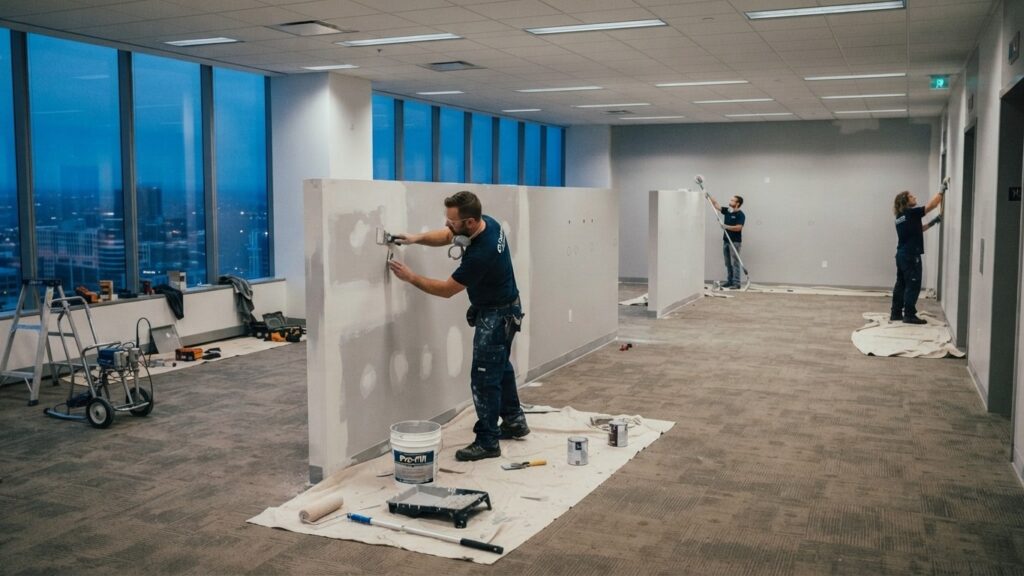
 At its core, the office decommissioning process means restoring a leased space to the condition required by the lease agreement. That typically includes removing furniture, fixtures, and equipment, patching walls, removing cabling, and returning the space to “broom clean” or better condition.
Sounds simple. It rarely is. To make matters worse, often it has been years removed from lease signing and multiple business driven space adjustments.
“Most tenants underestimate decommissioning until they’re staring at a restoration clause 30 days before their lease ends.”
Commercial leases often contain detailed restoration language that specifies exactly what must be removed, what can stay, and what condition the space must be in at handoff. Missing those details can mean forfeited security deposits, holdover penalties, or disputes with landlords that drag on for months.
The Compliance Piece Nobody Talks About
Compliance is where the office decommissioning process gets complicated fast. Depending on the building, the lease, and local regulations, a decommissioning project might need to address:
- Lease restoration clauses — exact requirements for wall patching, flooring, and fixture removal
- Electronics and data disposal — proper handling of servers, monitors, and devices containing sensitive data
- Hazardous materials — older buildings may have asbestos-containing tile or insulation that requires certified abatement
- ADA and building code requirements — if modifications were made during the tenancy, those may need to be reversed
- Certificates of destruction — for companies handling regulated data (insurance, legal, healthcare), documentation proving secure disposal is often required
For regulated industries — law firms, insurance brokerages, healthcare providers — this last point matters enormously. A firm cannot simply toss old file cabinets or hard drives into a bin. There must be a documented chain of custody, and that documentation needs to hold up if anyone ever asks for it. Even if the plan is to contract with a 3rd party for secure destruction, the proof of process is a must have.
“Compliance isn’t a checkbox at the end. It has to be built into the plan from day one, or it gets expensive fast.”
Sustainability: The Part That Actually Saves Money
It is tempting to think of sustainability as a nice-to-have, something companies do for optics. In office decommissioning, it’s often the opposite — sustainable practices are usually the cheaper path, not the more expensive one.
Landfill disposal is not free. Hauling and dumping fees add up quickly, especially for large furniture volumes. Every desk, chair, and filing cabinet that gets diverted from a landfill is one less item a company pays to throw away.
The alternatives are well established:
- Furniture resale or donation — usable furniture can often be resold or donated to nonprofits, schools, or startups, sometimes generating a tax deduction
- Material recycling — steel, aluminum, and certain plastics can be recycled rather than landfilled
- Refurbishment and reuse — some furniture can be refurbished for reuse in a new office, cutting both disposal costs and new furniture spend
- Responsible e-waste handling — electronics recycling partners ensure devices are processed safely and legally
“The greenest decommissioning project is usually also the most cost-effective one. Those two goals rarely conflict.”
A well-run office decommissioning process treats sustainability as a planning input from the start, not an afterthought tacked on after the dumpsters are already ordered.
Coordination: Where Most Projects Actually Go Wrong
If compliance is the part people forget and sustainability is the part people undervalue, coordination is the part that actually breaks most decommissioning projects.
 A typical decommissioning involves multiple moving pieces happening on a tight timeline:
- IT teams disconnecting and removing equipment
- Facilities staff coordinating building access, parking lot clearing and freight elevator schedules
- Movers and haulers scheduled for specific dates
- Furniture liquidators or donation pickups
- Final cleaning and restoration crews for patching & painting
- Landlord walkthroughs and signoffs
Each of these groups has its own schedule, its own constraints, and its own point of contact. Without a single party managing the sequence, projects slip. A hauler shows up before IT has removed the servers. A landlord walkthrough gets scheduled before restoration work is finished. A building’s freight elevator gets booked by another tenant during the exact window a company needed it.
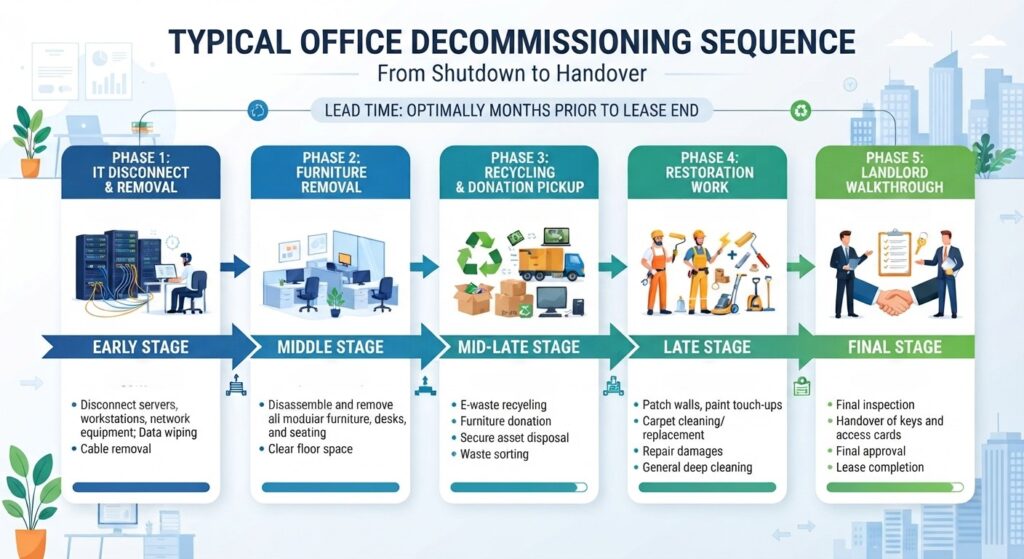
This is why an experienced project manager like MyOffice overseeing the office decommissioning process end-to-end tends to save companies both time and money. Someone must own the calendar, chase down vendors, and confirm every requirement is met before keys go back to the landlord.
Why This Matters More in California
California adds another layer to the office decommissioning process. State and local regulations around hazardous waste, electronics recycling (through programs tied to the state’s e-waste laws), and building material disposal are stricter than in many other states. San Diego and the broader Southern California region also have municipal recycling ordinances that affect how commercial waste must be sorted and reported.
Companies operating in regulated industries — insurance, legal services, healthcare — face additional scrutiny. Improperly disposed client records or data-bearing devices can create liability well after the office itself is gone.
Getting It Right the First Time
 None of this means decommissioning must be stressful. It means it needs a plan. Companies that treat the office decommissioning process as a structured project — with clear ownership of compliance, sustainability, and coordination — consistently come out ahead of those who treat it as an afterthought to their move.
That planning includes:
- Reviewing the lease restoration clause well before the move-out date – we suggest at least 90-days
- Building in extra time for hazardous material assessments, if the building’s age warrants it
- Identifying donation, resale, and recycling partners early rather than defaulting to landfill disposal
- Assigning a single point of contact to manage the sequence of vendors and timelines
- Documenting everything, from certificates of destruction to landlord sign-off
Conclusion: The Bottom Line
Clearing furniture out of a space is the easy part. The office decommissioning process is really about managing risk, controlling cost, and doing right by the environment along the way. Companies that plan for compliance, prioritize sustainability, and coordinate every vendor involved come out of the process with fewer surprises — and often a lower bill than they expected.
If your lease is approaching its end and you are not sure where to start, that is exactly the kind of planning conversation worth having early.
MyOffice San Diego partners with local businesses to plan furniture, technology, and infrastructure together from day one. If you are considering a change that requires some decommissioning of office space, let’s start the conversation now. Connect with our team today to schedule a complimentary decommissioning consultation.
MyOffice has over 20 years of experience in supporting client’s implementing office solutions. We understand the needs of the modern office environment. Optimizing your workspace through furniture selection and layout is a core competency of ours. We are here to help!